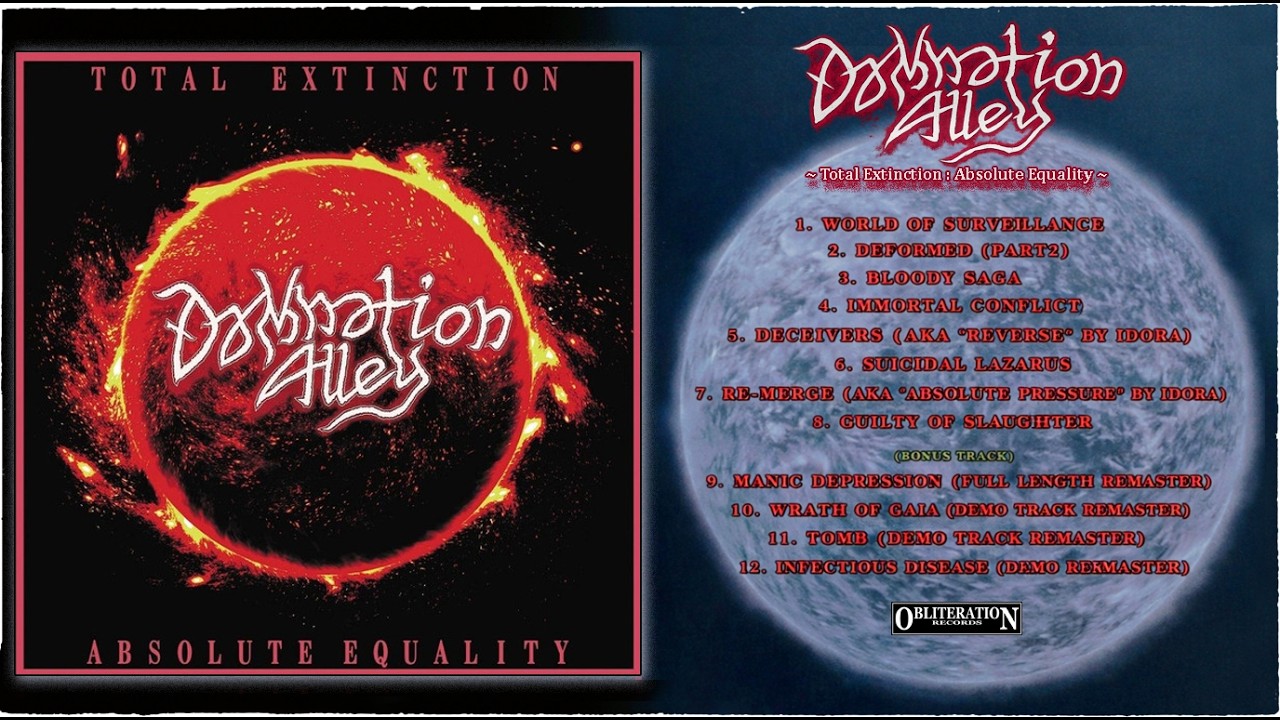
There’s a certain kind of Japanese death metal band that doesn’t want to be interpreted. No lore, no half-page band statement, no artful black-and-white promo shot of five guys staring into the middle distance. Just riffs, delivered with the bluntness of a dropped toolbox. Damnation Alley sit squarely in that lineage, and honestly, that’s the appeal.
I don’t think foreign listeners always get how much of Japan’s death metal underground works this way. The international picture of extreme music here tends to get filtered through a handful of exports — the weird ones, the theatrical ones, the ones with a gimmick that translates cleanly into a festival booking. Fine. But the bulk of the scene is bands like this: playing to rooms of eighty people, pressing small runs, keeping the whole operation running on stubbornness. The music doesn’t care whether you’ve heard of it.
The sound, plainly
What you get is death metal with its mechanics on display. Riffs that chug and then peel off into something nastier, tempos that lurch rather than glide, vocals pitched low enough to read as texture instead of language. There’s no attempt at the glossy, click-locked perfection that a lot of modern death metal chases. The playing has grit on it. You can hear hands on strings.
The band’s strongest trick, to be real, is momentum. A lot of death metal bands write parts; this one writes motion. A riff arrives, it does its job, and before you’ve finished processing it the floor’s already tilted and you’re somewhere else. That’s harder than it sounds. Plenty of technically superior bands never manage it — they stack sections like bricks and the thing just sits there, impressive and inert.
There’s old-school DNA in here too. The kind of death metal that remembers it came out of thrash, that still believes in a good headbanging tempo, that isn’t embarrassed by a mid-paced section where everything locks down and gets heavy in the old dumb satisfying way. If your reference points run through early-’90s filth rather than post-2010 polish, you’ll find the doorway pretty quickly.
Why this matters past the music
Bands like this are the connective tissue of a scene. They’re the ones who show up on a four-band bill at a basement venue on a Tuesday, play to a crowd that’s half other musicians, and go to work the next morning. That’s not a sob story — it’s just how underground metal functions here, and it produces a specific kind of music. Nothing is being made for an algorithm. There’s no career calculation audible anywhere in these songs, because there’s no career to calculate.
What that buys you as a listener is honesty. Japanese death metal of this stripe has a particular density to it, a refusal to let air into the mix, and I’ve come to think of that as a regional fingerprint as much as a production choice. Everything crammed into the frame. No breathing room. It’s claustrophobic in a way that American death metal rarely is, and that claustrophobia is the point.
For someone coming in from outside, the barrier isn’t the music — death metal is death metal, it crosses borders without a passport. The barrier is discovery. There’s no streaming playlist shepherding you toward bands operating at this level, no algorithm that’ll surface them between the big names. You have to go looking, follow the thread from one record to the next, trust the small labels and the distro tables.
So go find the recordings. Put them on loud, in a room where nobody’s going to ask you to turn it down, and let the riffs do what they were built to do. That’s the whole invitation.